
Last verified with: 10.8.6.0
Summary #
Share Plans in LogiSense Billing allow usage to be pooled across many subscriptions or services according to configurable business rules. They give organizations a way to model shared consumption scenarios where usage is not limited to a single service instance, but instead participates in a broader allowance or pool.
Why It Matters #
Many usage-based businesses need to support shared entitlements rather than isolated usage tracking per service. Share Plans make it possible to create flexible pooled-usage models that align with modern communications, device, and service offerings.
Business Problem It Solves #
Businesses often need to support:
- pooled usage across multiple subscriptions
- shared allowances for groups of devices or services
- fixed or dynamically growing usage pools
- commercial models where participation and contribution rules differ
- customer offers that combine individual and shared consumption behavior
Share Plans help organizations model those scenarios in a structured and scalable way.
Core Concepts #
Shared Usage Pools #
Share Plans allow usage to be consumed from a common pool rather than being billed purely in isolation at the single-service level.
Participating And Contributing Services #
Some services participate in the pool, while others may also contribute to the growth or size of that pool. This distinction is important for modeling how shared entitlements behave.
Activation Rules #
Share Plans can be activated based on configured business conditions, such as the sale of a specific service or the participation of certain service types.
Fixed Versus Dynamic Growth #
Pools can remain fixed in size or expand dynamically as additional participating or contributing services are added.
How LogiSense Supports It #
LogiSense Billing supports Share Plans through:
- definition of share-plan rules and parameters
- pooled usage behavior across large numbers of subscriptions
- support for contributing and participating services
- configurable activation and growth behavior
- alignment with bucket-based usage models
This allows businesses to create flexible shared-usage offers without needing to manage the logic outside the platform.
Common Use Cases #
Shared Family Or Group Plans #
A business wants multiple services or subscriptions to consume from the same pool of usage.
Device-Oriented Shared Entitlements #
An organization offers usage allowances that grow as more participating devices or services are provisioned.
Hybrid Pooling Models #
Some services contribute capacity to the pool while others only consume from it, allowing more sophisticated offer design.
Large-Scale Shared Usage Monetization #
The business supports high-scale shared-usage models across many active subscriptions in a controlled way.
Important Considerations #
- Share Plan design should be documented carefully because pooled usage behavior can be harder for customers and internal teams to understand than simple individual usage models.
- Participating, contributing, and activation rules should be clearly defined so the commercial logic is predictable.
- Shared usage offers should be aligned with product design, pricing, and customer communication.
- Share Plan documentation is most useful when it explains the business model behind the pool, not only the underlying usage mechanics.
Share Plan Structure #
Usage can be pooled between thousands, even millions of subscriptions. Pool sizes are fixed or grow dynamically as new services are provisioned based on pre-configured rules.
LogiSense Billing handles this functionality via share plans. With share plans, businesses have an incredible amount of flexibility at their fingertips to define business models around how their services and devices share pools of usage.
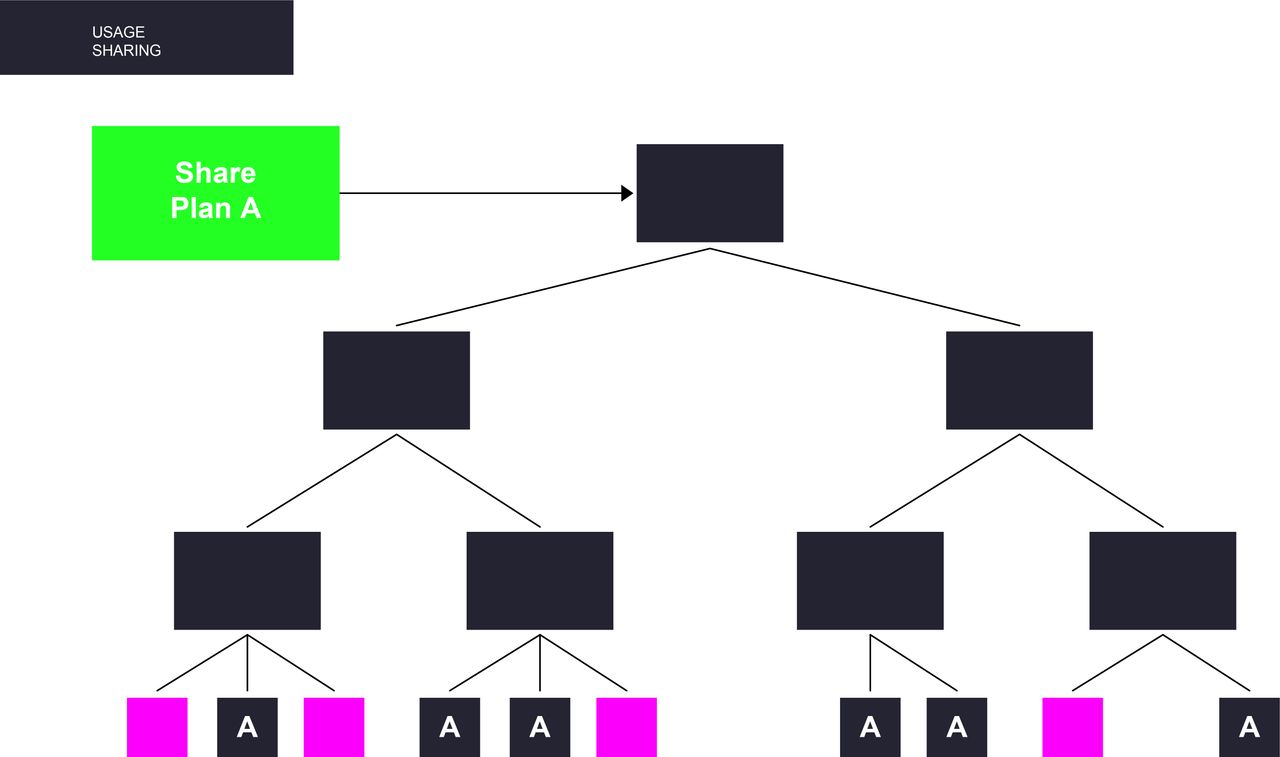
A Share Plan is an entity that defines the rules and parameters around how usage is to be shared. These include the following attributes:
| Attribute | Definition |
|---|---|
| Data Type | The type of data that is being shared. Bucket allocations can be attached to a share plan representing the class of usage being shared (data, time, count). |
| Activation Rule | The activation rule specifies the mechanism for activation of a share plan. Share plans can be activated through two mechanisms: (1) A selling service which means the selling service has to be sold to the account in order to activate the share plan. (2) A participating service which means that the participating service needs to be sold to an account in order to activate the share plan. |
| Contributing and Participating Services | Participating services are services that participate in a share plan – i.e. applicable usage associated with that service are pooled with that share plan. Each participating service specifies a contribution amount. A contribution amount greater than 0 indicates that the service not only participates but also grows the share plan “pool”. |
| Growth | Share Plans can have fixed or variable sized bucket allocations. With a fixed bucket all participating share the same pool of usage and the pool size remains the same irrespective of the number of services that participate in the plan. With a variable share plan, the share plan grows by a contribution amount for each contributing service. |
| Share Level | Share level specifies the level at which sharing occurs. A share level of Usage Invoicer indicates that all accounts and their usage based services that report to that account are eligible to participate in the share plan. A share level of account indicates that all services that are assigned to that account are eligible to participate in the share plan. |
| Usage Billing Frequency | The frequency at which usage gets billed (monthly, weekly, yearly etc.) for the share plan. |
Share Plan Configuration #
Configuration of a share plan occurs at the catalog level where the administrator defines the various attributes listed above. The administrator also chooses the participating services that can participate in the share plan. Once the share plan is defined and saved, the administrator can then define the share plan buckets and set contribution rules.
Share Plan Buckets and Contribution Rules #
Multiple bucket allocations can be associated with each share plan. When multiple buckets are configured, the bucket precedence rules come into effect. Fixed size buckets do not grow as more participating services are added to the pool. However, if a bucket is of a variable size, the bucket will grow based on how many participating services have been added. Each service can grow the bucket by a prescribed amount specified by its contribution value. It is possible for service A to grow a bucket by 100 min and service B to grow a bucket by 150 min even though they are part of the same share plan. An administrator may wish to set up the system in this manner for operational and reporting purposes.
Account Level Management of share plans #
Management of share plans at an account level is also possible. While the catalog level share plan configuration determines the default contributions for each account service, account level overrides can be initiated to change the amount that a participating service contributes. This can be extended even further. A service can elect to participate in a share plan even if it was not initially configured in the set of participation services at the catalog level – likewise a participating service can be opted out of a share plan at the account level.